
|
|
|
Soybeans
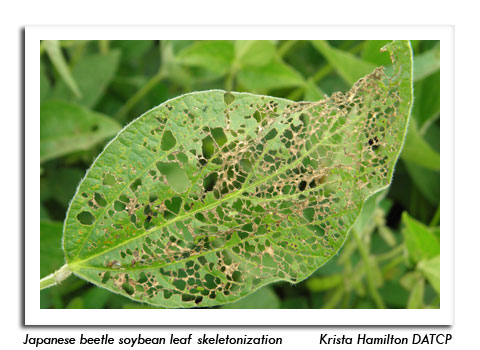
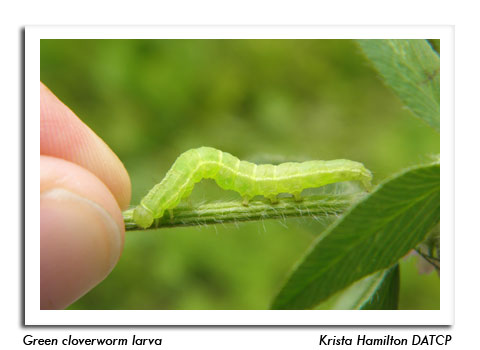
Volume 56 Number 20 Date 11/17/2011 SOYBEAN APHID - Densities remained below economic levels this season. The annual survey conducted in July and August showed the state aphid count to be 12 per plant. This average compares to 16 aphids per plant last year and is only marginally higher than the record low density of 11 per plant documented in 2004. Soybean fields were sampled in two intervals, first in late July and again in August, for a total of 284 observations in 142 fields. Aphid densities were below 103 per plant in all surveyed fields, with the exception of a single Portage County site which had an average count of 451 per plant on July 29. Natural control agents, insecticidal seed treatment, high temperatures, and several heavy precipitation events limited soybean aphid population growth in 2011. JAPANESE BEETLE - Adults became prevalent in flowering soybeans by late July and foliar damage surpassed economic levels during the first two weeks of August. Controls were applied to fields in Chippewa, Dane, Eau Claire, Kenosha, Rock and Walworth counties, with unsatisfactory results in a few cases. According to survey observations and reports, Japanese beetles were far more abundant this season than in the last several years. The largest populations were found on lighter soils in the southeast, south-central and northwest areas. GREEN CLOVERWORM - Larval infestations were common in soybeans throughout the state again this year, but defoliation levels were less severe than in 2010 and control measures specifically for this soybean pest were not needed. --Krista Hamilton, DATCP Entomologist SOYBEAN VIRUSES - Illustrated in the map below are the locations of 135 soybean fields (R2-R7) sampled and tested for alfalfa mosaic virus (AMV) and soybean dwarf virus (SbDV) this season. Sixteen (11.9%) fields were infected with AMV in 2011 compared to 12.9% in 2010. Soybean dwarf virus was found in five fields (3.7%), a decline from 7.7% last year. Lower populations of the soybean aphid vector may partially explain the decrease in SbDV-infected soybean fields in 2011. SOYBEAN SEED INSPECTION - Analysis of leaf and soil samples from 12 soybean seed production fields (161 acres) in Jackson, Outagamie, Fond du Lac, Rock and Shawano counties found downy mildew at 11 locations, alfalfa mosaic virus at 5 locations, frogeye leaf spot at 3 locations, Phyllosticta leaf spot at 3 locations, soybean cyst nematode at 2 locations, and bean pod mottle virus at 1 location. Inspections were negative for anthracnose stem blight, bacterial tan spot, Cercospora leaf blight, southern bean mosaic virus, stem canker, tobacco ringspot virus, and tomato ringspot virus. Disease incidence in 2011 was comparable to that of 2010. --Anette Phibbs, Plant Industry Laboratory 


|

|