
|
|
|
Forages & Grains
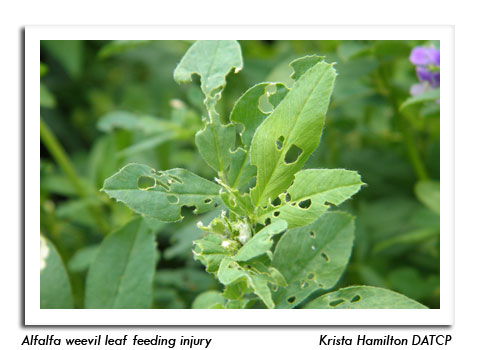
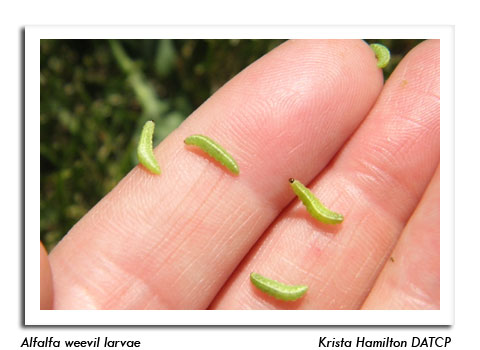
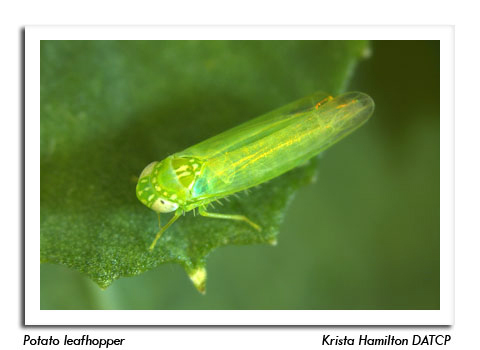
Volume 56 Number 20 Date 11/17/2011 ALFALFA WEEVIL - Larvae were noted in Sauk County alfalfa on May 17, nearly three weeks later than in 2010. Development was accelerated by record-setting heat in late May and weevils were numerous by June 2. Pupation began at advanced sites two weeks later. Alfalfa harvest in early June prevented most of the larval population from maturing, but rainy weather and competing corn and soybean planting schedules delayed operations in some fields, permitting damage to intensify. By mid-June, any first growth alfalfa that had not been harvested had severe infestations of 3-11 larvae per sweep and 40-80% defoliation. Damage subsided by late June as the remaining larvae entered the non-feeding pupal stage. POTATO LEAFHOPPER- The first distinct arrival episode of 2011 occurred from May 21-23 and migrants were widely distributed over the southern two-thirds of the state by early June. Nymphs appeared in second crop alfalfa from June 8-15. Surveys in June and July found low to moderate numbers, with representative counts averaging below 1.8 per sweep statewide. Economic levels of 2.0 or more leafhoppers per sweep developed in a small proportion of fields in late July and early August, but chemical treatment was seldom required this year. PEA APHID - Populations in alfalfa were comparatively low all season long. The highest count of 24 per sweep was found in a Washburn County alfalfa field on June 8, but this was an anomaly. Surveys from May-August found average counts of 2-4 per sweep. Pea aphids were not abundant enough to be of economic significance this season. --Krista Hamilton, DATCP Entomologist CEPHALOSPORIUM STRIPE ON WHEAT - The first confirmed case of Cephalosporium stripe on wheat in Wisconsin was found in 2011, in Rock County. According to Craig Grau of the UW-Madison, infections have been suspected over the years but never verified by laboratory analysis. Isolates from samples collected from the positive field were conclusively identified by the Plant Industry Laboratory and confirmed by the UW. Symptoms were found in only one field of 45 surveyed. STRIPE RUST ON COMMERCIAL BARBERRY - Stripe rust was identified from two barberry cultivars being offered for sale in Wisconsin nurseries. Barberry cultivars must be resistant to stem rust (Puccinia graminis) to be legal in trade in the Midwest. The two cultivars that showed signs of infection, 'Emerald Carousel' and 'Golden Carousel', had been tested by the USDA Cereal Disease Laboratory (CDL) and were on the approved list. Upon investigation by the Plant Industry Laboratory and consultation with the CDL, it was determined that the aecia observed were of P. striiformis, not the regulated P. graminis. While stripe rust is not a regulated organism, the presence of P. striiformis-susceptible barberry in the state may pose some of the same concerns as with P. graminis. --Adrian Barta, DATCP Plant Pathologist 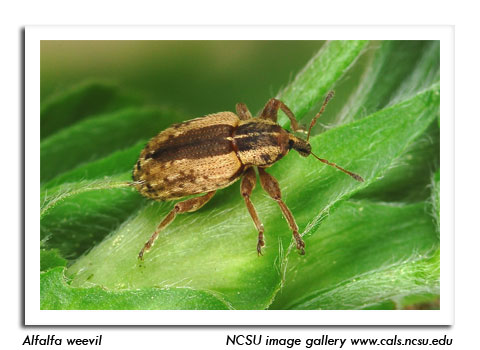
|

|